
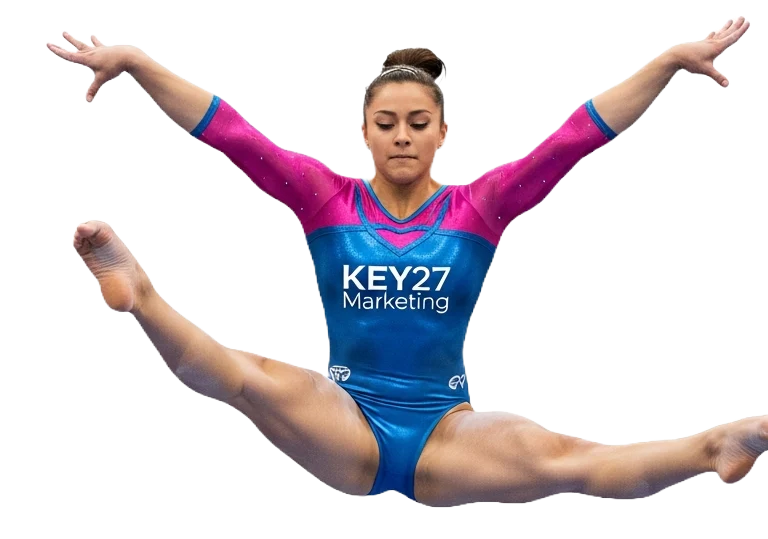
Got questions about gymnastics recruiting?
Here are common gymnastics recruiting FAQs that athletes and families often have about scholarships, timelines, and how the process works.

We recommend building your profile by age 15–16 and having initial contacts by 11th grade. Earlier is better.
Absolutely. Many international gymnasts qualify for both, increasing your chances of covering all costs.
Most NCAA Division I programs recruit athletes competing at Level 10 or Elite, with strong scores at State, Regionals, or Nationals. Division II and III programs also recruit Level 9 athletes who demonstrate clean execution, strong basics, and long-term potential.
For Division I and II, coaches may begin calling, texting, and emailing recruits on June 15 after Grade 10. In-person contact and official visits are allowed starting August 1 before Grade 11.
Division III coaches have more flexible rules and may contact athletes earlier.
Academics matter significantly. To compete in the NCAA, recruits must meet minimum GPA requirements and complete core academic courses. Strong grades also increase scholarship opportunities—especially for Canadian athletes entering U.S. colleges.
Yes. Division I women’s gymnastics programs may offer up to 12 full athletic scholarships, while Division II programs have the equivalent of six scholarships to distribute. Division III schools do not offer athletic scholarships but provide generous academic and financial aid packages.
Yes. Division I women’s gymnastics programs may offer up to 12 full athletic scholarships, while Division II programs have the equivalent of six scholarships to distribute. Division III schools do not offer athletic scholarships but provide generous academic and financial aid packages.

Yes, especially in NCAA Division I women’s gymnastics. Men’s programs may offer partials, but full scholarships are possible at elite schools.
1–2 minute clips of full routines at real competitions — labeled by event and score — are best. Include different angles if possible.
Most gymnasts begin preparing in Grade 9 or 10, but serious recruiting activity usually happens between Grade 10 and 12. Coaches evaluate athletes early, so it’s important to have videos, scores, and a recruiting profile ready before June 15 after Grade 10 (the first date DI coaches can contact gymnasts).
Coaches strongly value consistency, attitude, coachability, work ethic, injury history, and team fit. Many programs prioritize gymnasts who display mental toughness and reliable performance on events like Beam and Bars, even over difficulty upgrades.
Unofficial visits: You pay your own way; allowed at any age (DI coaches can't interact until the contact date).
Official visits: The college pays for travel, meals, and lodging; allowed starting August 1 before Grade 11.
Recruits typically take multiple unofficial visits before using one or two official visits to finalize choices.
Very competitive. There are only about 62 NCAA Division I women’s gymnastics programs, each offering up to 12 scholarships. Because many scholarships go to returning athletes, only a handful become available each year. Strong academics can significantly increase financial aid options, especially at private schools.
Most colleges are now test-optional, but some programs—especially for Canadian athletes—still recommend or require SAT/ACT scores for academic scholarship consideration. For NCAA eligibility, standardized tests are no longer mandatory, but maintaining strong grades and completing the required 16 core courses remains essential.
Most student-athletes combine multiple forms of aid — athletic, academic, and need-based — to build the best overall package.
Build a standout recruiting profile
Share your highlight videos with U.S. coaches
Identify the right college level for your skill set and academics
Have questions? Want to know how to get started? Fill out the form below, and one of our advisors will respond shortly.
 Optimized by Seraphinite Accelerator
